
Archive for June, 2009

PokerShark: Gaining an Edge at Online Poker

This is post #9 in an ongoing series of articles about my work as a poker bot developer.

Imagine you’re an online poker player and you suddenly have the ability to only play bad opponents. Say goodbye to the tough, aggressive, profitable players and say hello to the legions of loose, passive fish that make up the online poker community.

With a little bit of work, that’s exactly the situation I found myself in.

Some background: When I started playing online poker in early 2005 I was immediately drawn to one vs one No Limit Hold’em tournaments, known as Heads Up Sit-n-Go’s (HUSNGs). They’re fast, exciting, and they require an increased attention to psychology that you don’t get as much of at the full ring (9 players) tables.

Here’s how you join a HUSNG (this will become important later):

1. Find an upcoming tournament.

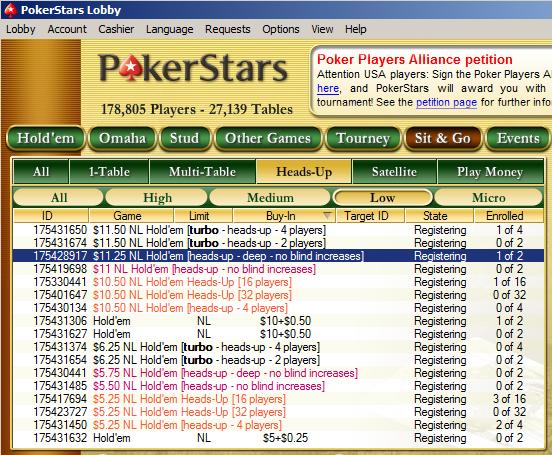
The PokerStars lobby helps you find exactly the type of game you want to play.
2) Open up the Tournament Lobby.

Once you’ve found a game that you like, double click it to open up the tournament lobby:

The lobby displays important information about the tournament such as how much it costs to play (the buyin plus the rake), the payout, the blind structure, etc.

It also shows you how many other people are registered in the tournament. If you’re the first one to register,  the list on the right will be blank, otherwise it will show the name of the person who already signed up.

3) Register. When you’re ready to play, click Register and join the tournament.

As soon as the table fills up with two players the game begins.
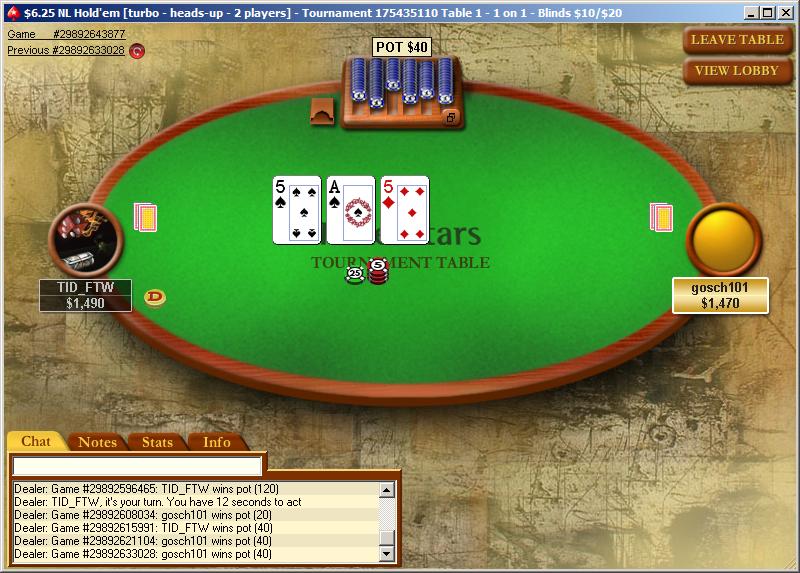
You can join a tournament any time you’d like. As soon as one fills up, another one is automatically created. During peak hours it can actually be a challenge to sign up for one because so many people are trying to register at once.

With thousands of people playing at the low and medium stakes, you can literally play for weeks without facing the same opponent twice.

This is fantastic news if you’re up against a tough opponent because you know that you’ll probably never face him or her again. BUT, if you’re playing some donk (a donkey–a bad player), it’s frustrating for the exact same reason: you’ll likely never play him again. And you want to. You really want to.

One important point: For a few minutes after a HUSNG ends, you can still locate it and check the results:

Why PokerStars let’s you access this is beyond me.

Anyway, after a few months of playing the HUSNG opponent lottery, I decided to see what I could do to improve the situation. I set out to create a program that would record the results of every HUSNG played on PokerStars and then use those results to determine which opponents to play and which to skip.

Several months and many iterations later, it was built. I called it PokerShark. (The original version was called PokerSanta but I decided that was kind of girly and changed it to PokerShark.)

24/7 I had a program running that recorded the winners and losers for every HUSNG and when I was ready to play, I ran a second program which opened up tournament lobbies and waiting for a player to register. As soon as someone registered, the program checked the player’s previous results and determined if he was mediocre enough to play. If he was, the program would automatically register me for that tournament.

The results were simply incredible:

Here’s what the software looked like: (click to expand the screenshots)

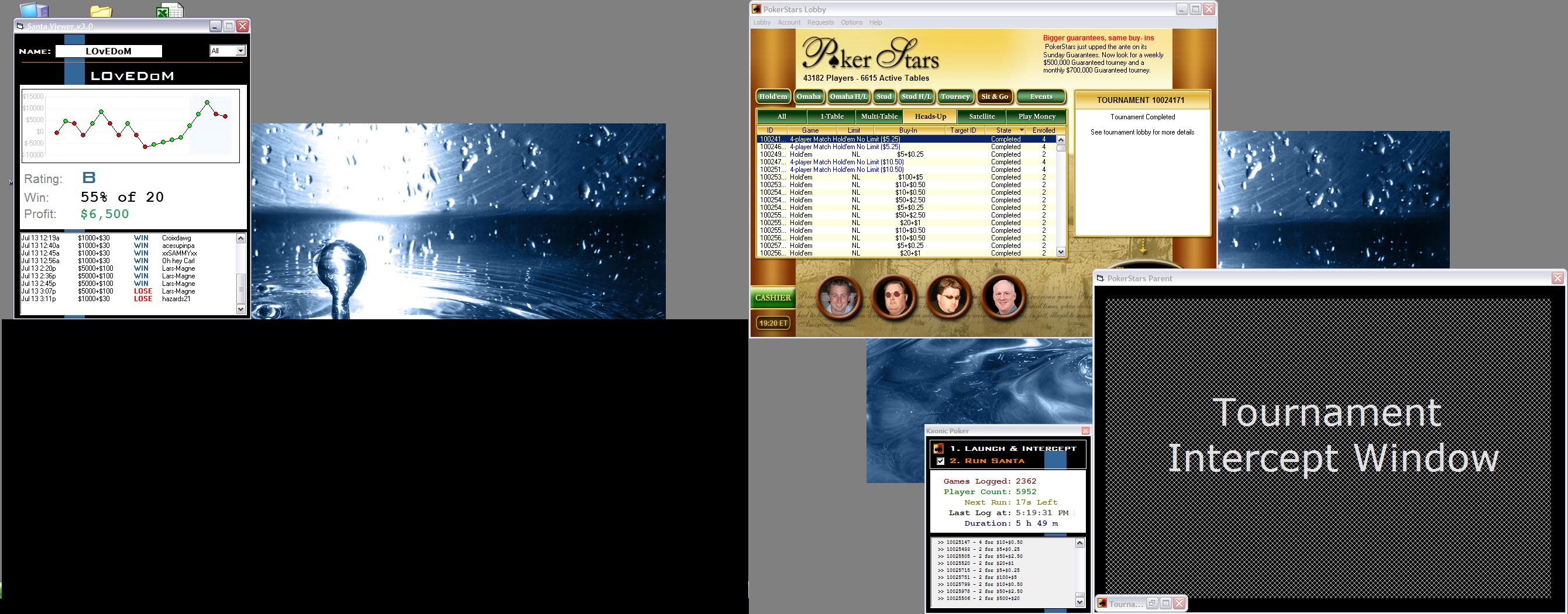
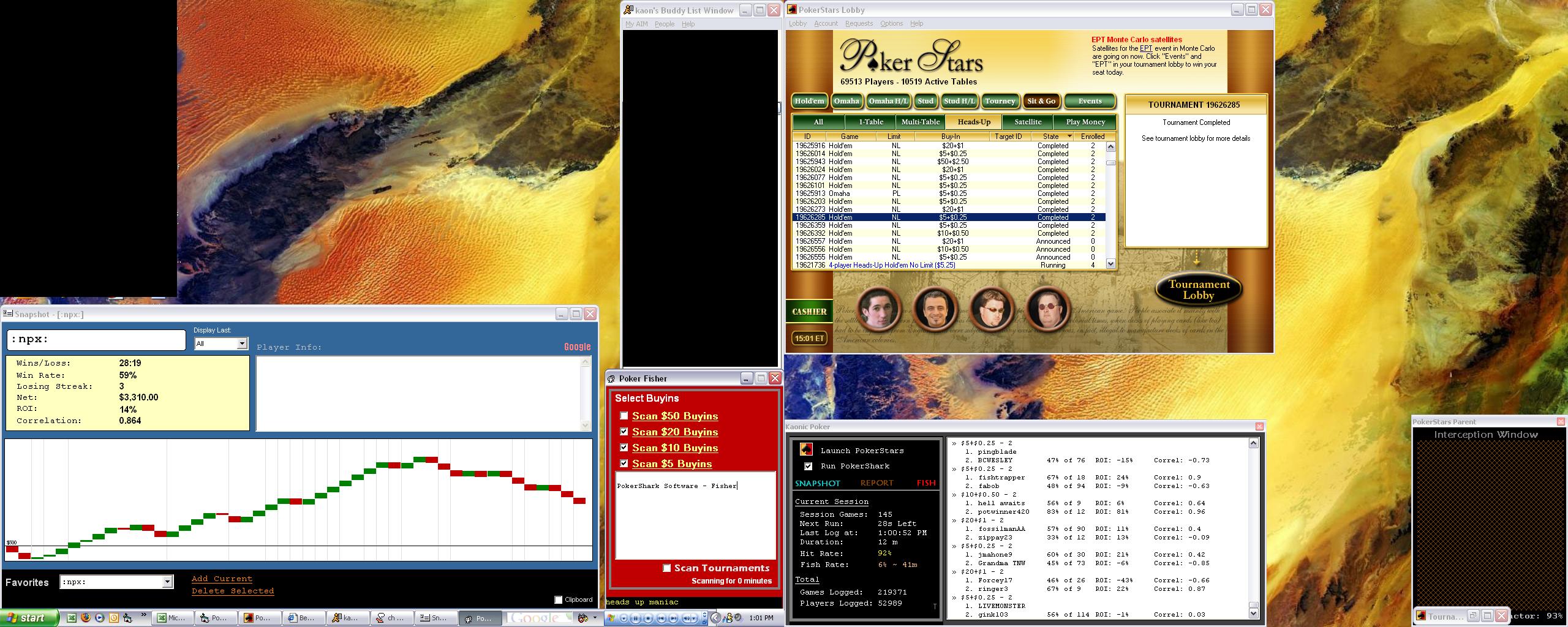
July 13, 2005:

At first, I focused on the software that recorded the results.

The window on the left was my attempt at concisely visualizing the recorded results.

The small, busy window below the PokerStars lobby displayed collection statistics and the large “Tournament Intercept Window” intercepted the Completed tournament windows as they were opened so it didn’t steal the focus away from anything else I was doing.
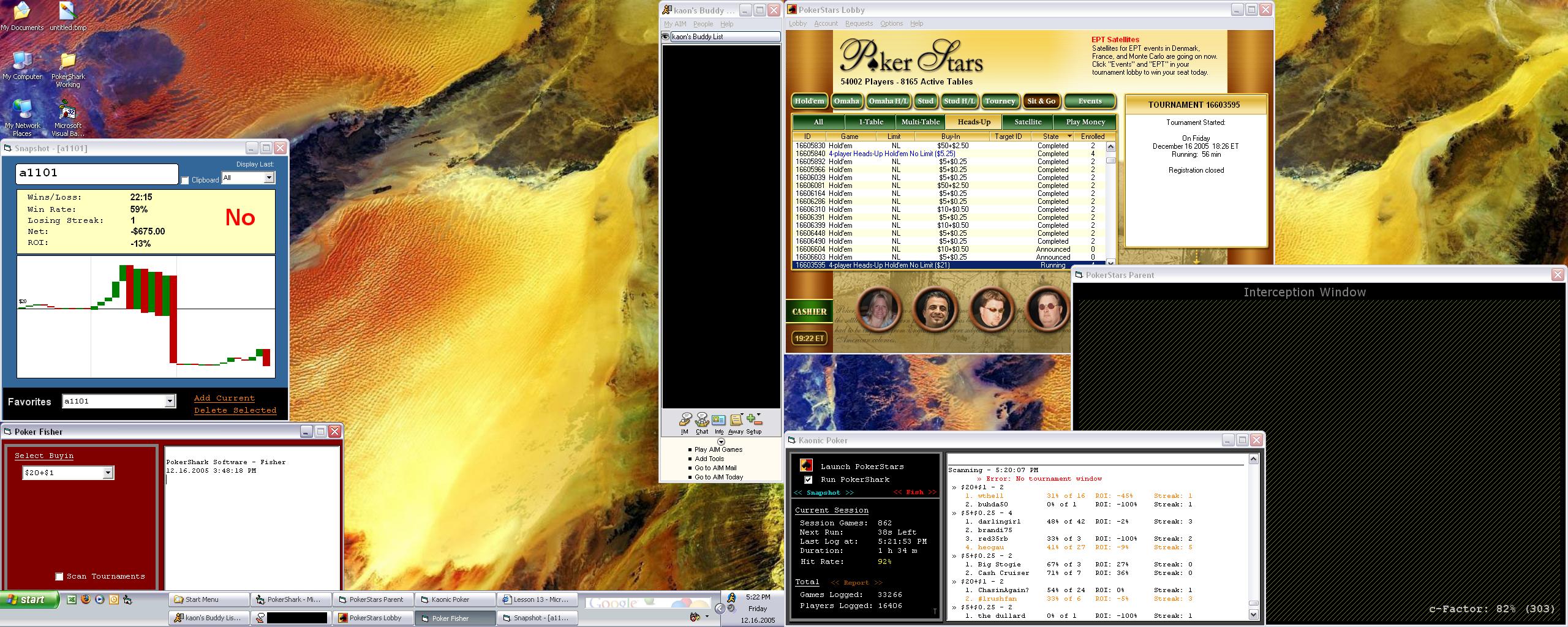
December 16, 2005

The ugly maroon window on the bottom left was my first shot at automating the registration process.
February 16, 2006

Eventually I added support for multiple buyins and made the interception window much smaller.
There were a lot of interesting graphs…

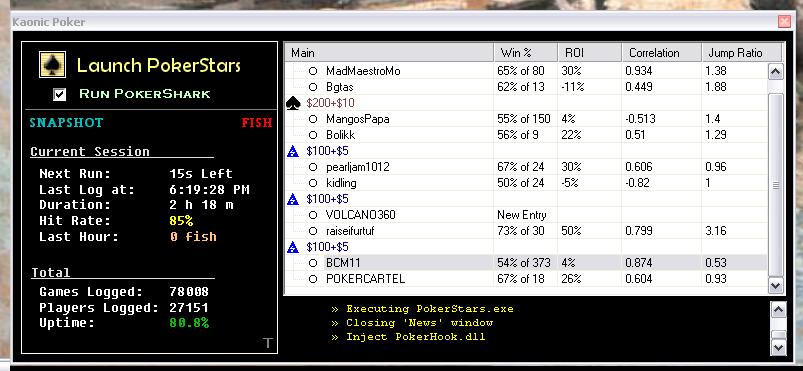
July 7, 2006

Over time I improved the design (note the little icons next to the buyins) and added extra analysis criteria such as jump ratio, which measured the stakes a player was currently playing compared to his average stake. Higher jump ratio = more tilt = more I want to play.
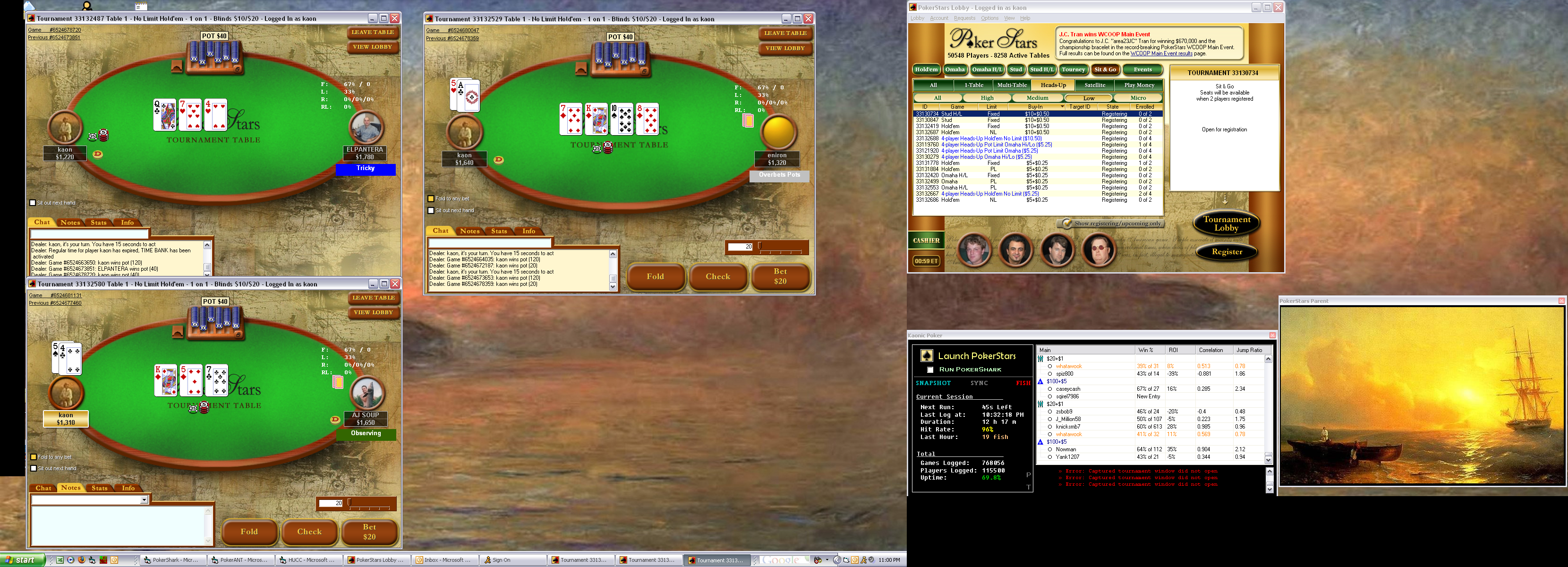
October 5, 2006

Notable on this one is the statistic overlays on each of the tables, which was another program I wrote that helped me make better decisions.
Using this software was a trade off. On one hand I didn’t have to face any tough opponents, so the money came easily and I didn’t have to face a lot of the stress typically associated with heads up games. However, because I was playing against a terrible opponents, I picked up a lot of bad habits which actually made me a worse poker player. It’s funny how things work out.

By October 2006 I had had acquired a ton of experience programming add-ons for the PokerStars software, and decided to take it one step further and to try to build a bot.

I mean, how hard could it be? =)

Feynman: Take the World from a Different Point of View

No Limit Hold’em Poker Bot Profits by Effective Stack Size

This is post #8 in an ongoing series of articles about my work as a poker bot developer.

Two weeks ago I posted a chart of the poker bot’s net income for its last full month of play, September 2008. As a poker player, your net income is a crucial figure because it determines what you can actually buy with your hard earned profits. That’s the number you would tell your non-poker playing friends if they asked how you were doing. However, net income only paints part of the picture. To truly measure your results and your progress, you have to break down net income and analyze exactly where your profits and losses are coming from.

As a bot developer, identifying and eliminating weaknesses in the bot’s play were crucial to making it profitable. One way I did this was to break down its results into groups based on its effective stack size.

Effective stack size is best explained by example: Say you’re playing No Limit Hold’em with one opponent and you have $25 and he has $10. The important thing to realize is that your opponent cannot risk more than $10 in a single hand because that’s all he has in front of him. If he can’t risk more than $10, you can’t win or lose more than $10 either. Your effective stacks, therefore, are $10. It’s what you’re effectively playing with.

Put another way, your extra $15 does you no good playing against an opponent that can only risk $10. Because that extra $15 is not in play, you should devise your strategy based on the effective stack size; not your actual stack size (stack size should play a central role in your poker strategy).

Furthermore, you shouldn’t measure the size of your stack in chips or in dollars; you should measure it in terms of big blinds.

Consider this: you’re playing $1/$2 Heads Up No Limit Hold’em with a $200 stack. You’re the small blind and dealt pocket tens. All other things considered equal, you should make the same move as if you were playing $100/$200 with a $20,000 stack because in both cases, you’re playing with a 100 big blind stack ($200/$2 = 100, $20,000/$200 = 100). You could also measure your stack in terms of how many small blinds you have, but the standard is usually big blinds.

Q. You’re playing a Heads Up No Limit Hold’em Sit-n-Go (HUSNG) and the blinds are 25/50. You have 2,000 chips and your opponent has 1,000. What’s your effective stack size in big blinds?

A. You can’t risk more than 1,000 chips in a hand, so your effective stack is 1,000 chips, or 1,000/50 = 20 big blinds (bb).

When you start a HUSNG you’re given 1,500 chips and the blinds are 10/20, so you have a 75bb effective stack, meaning that in a HUSNG, you can never have more than a 75bb effective stack. If the blinds jump to 15/30 and you still have 1500 chips, you have a 1500/30 = 50bb stack.

The bot’s strategy changed depending on the effective stack size, which is why I broke down the net income into the different groups. The groups might seem strange (ie: why “22-35 bb’s?”) but there’s a method to the madness. Some of it is based on postflop stack to pot ratios and some of it simply based on preflop stack size.

Finally, “5 bb/100″ means that the bot won, on average, 5 big blinds every 100 hands. Measuring bb/100 is the standard way to gauge a player’s ability and what is a good number will vary based on the stakes and type of game.

This is all a long way of saying here are the results of my poker bot for its last three months of play broken down by effective stack size.

50 – 75 Big Blinds

21,479 hands @ 31 bb/100

~

35 – 50 Big Blinds

12,279 hands @ 14 bb/100

~

22 – 35 Big Blinds

11,615 hands @ 4 bb/100

~

15 – 22 Big Blinds

5,688 hands @ 5 bb/100

~

10 – 15 Big Blinds

6,609 hands @ 5 bb/100

~

0 – 10 Big Blinds

5,076 hands @ 3 bb/100

ALL IN Expert on PokerStrategyForums.com

Pardon me if it seems like I’m bragging–it’s just that I had pretty given up on ALL IN Expert so it’s really a pleasure to finally see it being discussed.

From PokerStrategyForums:

Another cool program I just recently found is called All-in-Expert. Its kind of similar to pokerstove in that it deals with ranges but its just for preflop play. You put in the amount in the current pot, the amount you have to call all-in and define your opponents range, and the software pumps out a grid of all possible hands and tells you whether you should fold or go all in with each hand and it gives you your ROI against your viillains range.

This tool has helped me a lot in dealing with those super tight shortstack players that only play premium hands. I was raising them all-in with hands like AK and JJ which was actually a mistake. The only hands I could profitably raise them with were QQ+. Even when I raised first in to 3xbb and they pushed all in for 20bb I found that calling with AK was a mistake. The better your pot odds get, the more hands you can profitably add into your calling range.

“Determine Never to Be Idle”

This is one of the most creative things I’ve ever seen.

It’s hard to describe why. Something about the author’s juxtaposition of the paintings and the photography or the simple, clever writing in that playful white font. My initial impression was that it was a sloppy mess, but the more I looked at it the more I realized that every word of every sentence was deliberate and purposeful. It’s inspiring.

The author wrote a piece on Lincoln too.

Introduction: Heads Up No Limit Hold’em Sit-n-Go’s

This is post #7 in an ongoing series of articles about my work as a poker bot developer.

There are two ways to play poker: cash games and tournaments.

In cash games, your chips are worth dollar amounts. When you bet $20, you actually risk $20. You can usually start and stop playing at any point and when you’re done, you trade your remaining chips in for their cash value.

In tournament poker, chips don’t represent dollar amounts. This is usually the type of poker you see airing on ESPN and the Travel Channel. You pay money to join the tournament, get a certain number of chips, and then play until you lose all your chips or win everyone else’s. You get paid based on how many people are left when you lose all your chips and that amount varies based on the structure of the tournament.

Sit-n-Go’s are basically fast tournaments. They’re specially designed not to last very long.

There are many types of Sit-n-Go’s depending on what type of poker you enjoy playing: 2, 4, 8, 9, 27, 180 people, Limit, Pot Limit, No Limit, Omaha, Stud, Razz, HORSE, etc.

The poker bot I designed was for Pokerstar’s Low Stakes Turbo No Limit Hold’em Heads Up Sit-n-Go’s, or, simply, HUSNGs.

That means:

  • PokerStars – One of the leading online poker sites
  • Low Stakes – The bot is profitable at the $2 + $0.20, $6 + $0.25, and $11 + $0.50 levels
  • Turbo – The blinds increase every 5 minutes instead of the normal 10
  • No Limit – You can bet your entire stack at any point
  • Hold’em – Two holecards, five community cards (flop, turn, and river).
  • Heads Up – You and one other opponent
  • Sit-n-Go’s – They usually last about 15 minutes.

HUSNGs were my specialty (I’ve played about 130K hands) and what I knew the most about, which is why I chose them for the bot.

To join a HUSNG, you pay a buyin and a rake. $6 + $0.25 means that the buyin is $6 and that you also have to pay $0.25 to PokerStars in order to play. That’s how they make their money. If you win the tournament, you win both buyins ($12) for a net profit of $12 – $6 – $0.25 = $5.75. If you lose, your opponent gets your buyin, so you’re out $6.25.

When the HUSNG starts you get 1500 chips and the blinds are 10/20 (the players alternate posting 10 chips and 20 chips before the cards are dealt). Five minutes later they jump to 15/30, then five minutes later 25/50, 50/100, 75/150, 100/200, and so on. Most games end before the blinds reach 75/150.

Here’s what it looks like:

With that out of the way, we can start to discuss the theory behind the poker bot’s decision making algorithms.

More to follow…

Learning Flash

I just finished Chapter 6 of Flash CS4 Professional Digital Classroom:

I’m fairly certain if you keep this on loop and watch it for more than 30 seconds your head will explode.

ALL IN Expert Featured on 2+2

ALL IN Expert, the poker calculator I released about a year ago, was recently demoed in a long article on the 2+2 poker forums.

Here’s the full post, written by *Split*:

Shortstackers. I hear more complaining about shortstackers than anything else in the poker world. Why? Because these people have found a mathematical loophole made possible by the current minimum buy-ins on poker sites. But why the hate? Apparently there is a loophole, why would one hate someone for doing something they could just as easily do themselves? Why doesn’t everyone tick that “Buy in for the minimum” button as they sit down at their table? Why doesn’t everyone use a simple hand chart, with certain stipulations, and grind 24 tables?

The answer is simple, and actually is the same as that old adage “you get out what you put in”. If you are using very minimal brain power, if you are simply following a hand chart, if you are mindlessly pressing buttons, then you have put in very little and in return, will make very little. A shortstackers winrate is severely capped given the simplicity of the strategy.

As it stands now, there are 3 main types of actual SS (the ~20bb variety)

The “nittynitty”: This is the 5/5, 4/4, 5/4 type that is most likely following a simple hand chart. The last time I drew up a SS chart without any variety it came out to 6/5.7, and that was pure robotic SS-ing. This player type doesn’t think and most certainly doesn’t use any sort of variation in play. They look at their cards and go “ok, I have this position, there are this many limpers, my chart says to do this” and they do it. These players are amaaaaaaaaaaazing to have on our left as we can powerhouse their blinds every single orbit and have an insane ROI/steal

Quote:
Why they suck for us? It really only sucks when they are on our right. They really don’t light steal, so they just take up space and we can really never win an easy pot against them. They also plague tables, and lots of tables, because their strategy is so simple (basic FPP strategy really) and they play for long hours.

The “pro”: This is the good kind of SS’r. They tend to run stats like 7/7, 9/8, and almost never have a vpip of 10 or higher, and almost never have a vpip/pfr gap of more than 1. They have a bassline of actions (what hands to shove v a raise from every position, hands to squeeze with over how many callers, etc), but they also understand variation. They will sometimes light steal, they will also utilize SC’s to their advantage. They make you call them a bit wider, which may get you tilty when you run into their top side a few times.

Quote:
Why they suck for us? Our edge against them is pretty small. They understand what they are doing, and will mix it up well. The big reason they suck is because they leech the games. They don’t take much per session, but overtime, they are leeching a significant amount of BI’s per level, especially when there are multiple of them. They become much more prevalent at 100NL and 200NL, but there are some at 50NL as well.

The “going2lose”: This is our most profitable SS’r to play against. They are terrible and have terrible stats to back it up. Why do they buy in in for 20bb? Because they fear losing money, have it as an “auto-option”, or try to use a chart and then go nuts. They tend to have a gap of 2+ in their stats, and most have vpips of like 11+. It is very standard to see them like 12/4, 19/6, or even 9/5. They have wide ranges, call shoves poorly, go absolutely insane in positional pots, and just make endless mistakes. Do not avoid them, just adjust your calling and re-shove ranges appropriately.

Quote:
Why they suck for us? Well they don’t actually suck for us! They are profitable for us so long as your range adaptation is solid.

What Can I Do To Improve Against Them!?

There is an awesome program called “poker stove” that I went over how to use in this video. However, there is another awesome program called “All-In Expert” that has made it very easy to figure out not only your exact range of shoving/calling (given factors like stack sizes, opening ranges, calling ranges, etc), but also the exact profitability of each hand.

But how do we know their ranges? Start thinking about it. I have actually had students before that had trouble against SS’s, so I told them to spend a week creating a SS-ing strategy and then we reviewed it. Amazingly enough, this simple exercise (that took maybe 2-3hrs for them), made it so they understood every range of a SS’r, how position changed their ranges, and most importantly, how to counter it. After spending maybe a total of 4hrs on everything (doing the work themselves, working it out with me, etc) they had it so they never had a tough decision against a SS’r. Now, if you are reading this paper to figure out exact ranges, I apologize…Just consider this super beneficial homework =)

Also, think logically while playing. Of course, it is easiest to play against a nittynitty, the ranges are concrete and they play super straight forward (in fact, you could probably find the EXACT chart they are using if you explore the internet). Logically, we know that if we raise TT UTG to 3bb, folds to him OTB and he shoves for 20bb, we know his range is super strong, probably TT+/AK (and in all actuality, it is probably QQ+/AK ~JJ). If we pokerstove it, we get 34/66. We know we are getting 23:17, so we need 42.5%ee to call. We have 34, so we cannot call. This is simple math.

But what if that OTB player was a “going2lose” player who was 18/9. We think his range is wider (because it is) and probably 66+/KQo+/AJo+. Against this range, TT is 53/47, so we would call. This is logical and mathematical. The good, though most people view is oppositely, is that SS’s force you to work through these math issues, which in turn makes you much stronger in other facets of the game. One of the easiest strategies I can suggest for ranging is to figure out a nittynitty’s range, and then expand from there based on looseness. That should help quite a bit.

Also, here is just a basic look at/tutorial of All-In Expert:

This is what we would call a shove with. I the pot is 24.5 because I assume that I raised to 3bb, the blinds make up 1.5bb, and the SS shoves for 20bb. I designate his range, which in this case I said was 99+/AT+, and some mixup hands like 22-55, AT, etc

This is what AIE says I should call with. If you were using the program, you could hover your mouse over and hand and get the ROI on it and see exactly how profitable it is

This is what we would want to shove with. I assume the SS’r raised to 3.5bb, there are 1.5 in blinds (so 5bb is the current pot). I assume I am not in a blind, so I would have to call 3.5bb, and if I shove, the SS’r would have to call 16.5bb. I say his current range is a steal range of 30% of hands (this is not for a nittynitty player obvi), and that he will call very wide (this is certainly a “going2lose” calling range in certain spots).

This is what AIE says is our profitable shove range. Notice, this does not take into account other players, and really, you should only 3b in this spot to like 14bb to ensure we don’t lose too much if/when other players wake up with really strong hands

“”Dieting: A system of starving yourself to death so you can live a little longer.”
Jan Murray ”

What the hell does a dieting quote have to do with shortstackers? Your bankroll is the diet of a shortstacker. He is mathematically entitled to it. You can work hard so you have a small edge against them, but it takes work. So how do you stop feeding them? DON’T PLAY WITH THEM!

It is very simple. If there are shortstackers at your table, don’t play. Now this may seem like an idealogical statement (especially for those who do loathe shortstackers), but it is possible to put yourself in better spots. Table selection rules involving shortstackers:

1.) NEVER sit at a table with more than 3 more shortstackers

Quote:
tables with too many SS’s are terrible for our WR. Our WR is not very high against a SS in the first place, so when you add more of them, it only gets worse. Leave tables if they get invested…the fewer the better, always

2.) There is a huge difference between 20bb and 60bb people.

Quote:
DO NOT confuse them. 20bb people are SS’s. 60bb buy in short, but are terrible for a whole different set of reasons. You cannot use the same strategy against each, so don’t even try to.

3.) Deepstack tables don’t allow shortstackers

Quote:
Although these tables tend to be a bit more reg filled, it is much better than sitting with 5 SS’s

So going full circle to answer the original question of “why does everyone hate shortstackers?”…the answer is simple. Because people are too lazy to figure out how to work around them. Too lazy to figure out the simple strategy and hand ranges to call/shove with to beat them. Too lazy to solidify their own game against them, that, oddly enough, would eliminate them. So people don’t hate shortstackers, they hate the work (albeit very little in reality) they have to do to beat them. Don’t be lazy, put in the work and time to make these shortstackers not only profitable for yourself, but to eventually rid of them. Enjoy and good luck with your work and winning flips!

Go Fish!

I’ve started learning Flash with the help of an excellent book titled Flash CS4 Professional Digital Classroom.

Here’s the culmination of today’s work, which is based on the tutorial in Chapter 3.

I’m quite proud of it myself.

Man Builds Toothpick City

Scott Weaver, 49, spent 34 years building a city out of 1M+ toothpicks:

Click here to read the entire article.

The best line from the interview is at the end when he says:

“The lesson in this is what do we do with our time. And I love to create. I love to show people what can be done in life if you spend time to create. Use your imagination.”

Embedded video from CNN Video

Next Page »