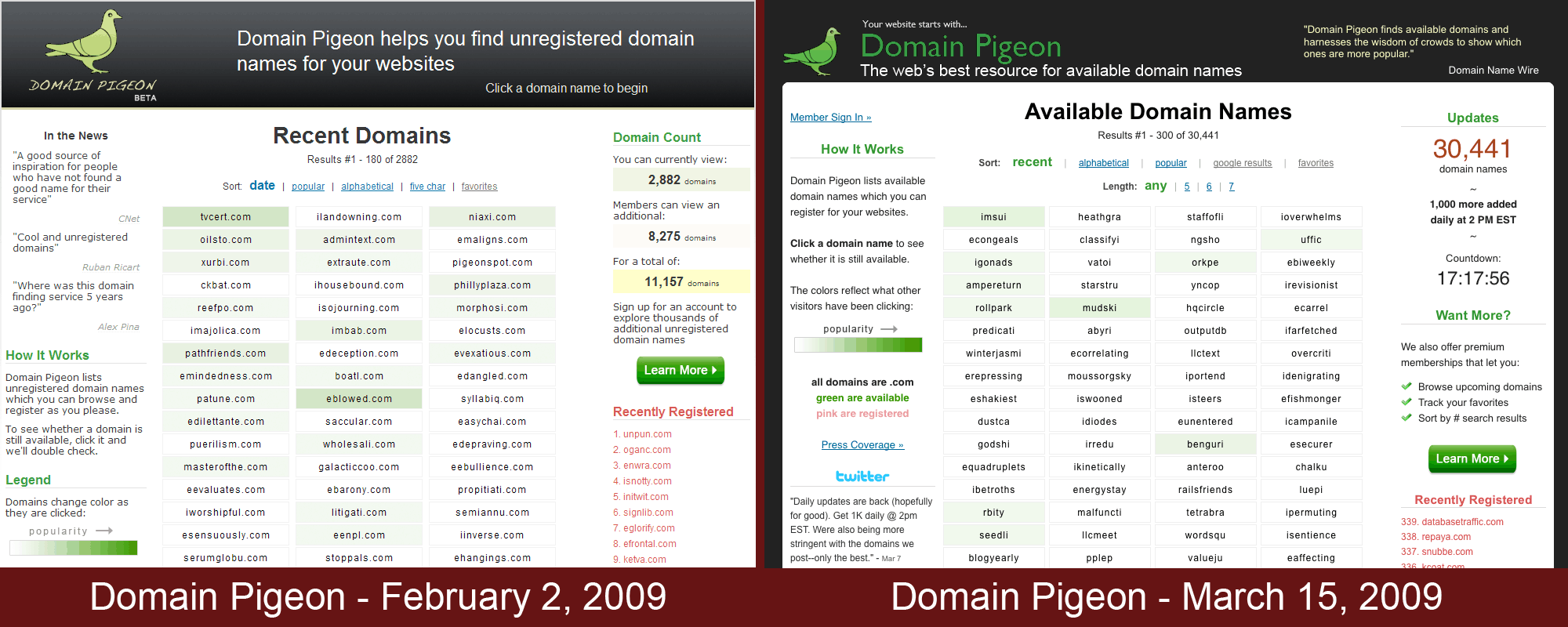
On January 29th I launched Domain Pigeon, a web site to help people find available domain names. The site lets visitors browse thousands of available .com domain names which they can register for their websites. It’s been more than six weeks since the initial launch and I wanted to do a recap of how things have been going as well as write about some of the lessons I’ve learned from the experience.
By the Numbers
Domain Pigeon has received more than 18,000 visitors and more than 62,000 page views since its launch. The average user spends about three and a half minutes on the site and looks at 3.4 pages. The site has a 45% bounce rate, meaning about 55% of the visitors look at more than one page.
The traffic looks like a positively skewed distribution:
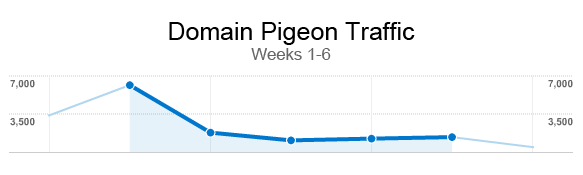
The post-launch spike was a result of traffic from Hacker News, CNET, and ReadWriteWeb (RWW).
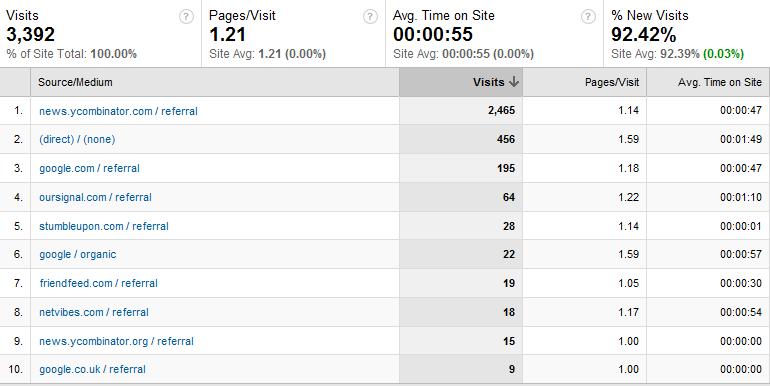
Currently the site receives about 1,700 visitors a week. The majority of the visitors (55%) still come from the CNET and the RWW articles; about a third come from direct traffic and the rest are from search engines.
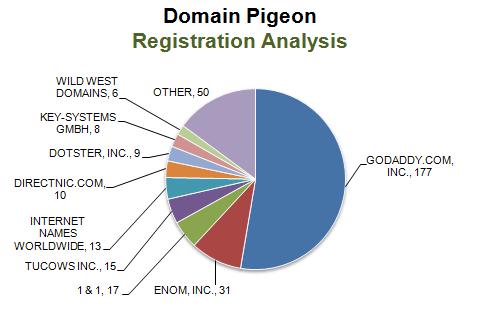
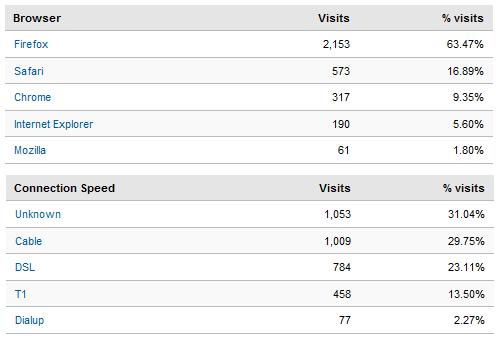
The most important statistic, however, is the number of domains that have been registered. So far more than 339 domains have been registered. GoDaddy takes the majority of those with 177 out of the 339:
Lessons Learned
Have a Flexible Business Model
Domain Pigeon originally made money in two ways:
The first was paid accounts, which let account holders access four times as many domains as guests to the site. At the time of the launch this meant that account holders could browse about 12,000 domain names and guests could see about 3,000.
I had my doubts about whether people would sign up. I hoped that people would see that the registration fee was a small price to pay if Domain Pigeon helped them find a good, cheap domain name for their website.
During the planning phase I set the price of an account at $9.99, but I decided anyone who would pay $9.99 would probably also pay $14.99 and the loss in customers would be made up for by the extra money. My friend Rob suggested that the price end with a 5 instead of a 9 because it looked less like a scam. $14.95 it was.
The second revenue source was affiliate revenue. I signed up for an account with Commission Junction, which GoDaddy and a few other registrars use to manage their affiliate programs. The idea is that if someone goes to Domain Pigeon, clicks “Register” on one of the domain names and then follows through with a payment, I get a percentage of the sale. I had no idea how much money this would bring in, but didn’t expect much.
No one signed up for an account on the launch day, which worried me a bit. Fortunately, the next day I was hacking away when all the sudden I saw an email pop into my Gmail account: “Notification of payment received” Ha! I emailed my wife, who was at work, a quick message touting this momentous event. A few minutes later another email came in. Someone else had signed up. A minute later another one. “3!” I exclaimed in another email to her… What the hell was going on?
It turned out that Josh Lowensohn, a CNET blogger, had (I figure) seen the HackerNews post and written about Domain Pigeon. Not only had someone on CNET written about Domain Pigeon (and this is where the crazy optimism started), but all of the sudden people were signing up for accounts.
The next few days were great. The site was receiving a lot of traffic and people were busily signing up for accounts.
A week after the CNET article came the ReadWriteWeb article. During the three days after the RWW article Domain Pigeon saw 6,400 visitors, 13 account sign ups at $14.95/account, and $275 in affiliate revenue. The site had become profitable and life was good.
At the time visitors could register a domain through one of six registrars. After the surge in traffic I took a close look at which were bringing in revenue and GoDaddy took the cake. Something like 95% of all the registrations were through them despite having six to choose from. I decided to simplify things for users and to focus exclusively on GoDaddy, hoping that minimizing the visitors’ options would make life easier for them and increase revenue for me. That was change #1.
There were some clouds on the horizon. I was adding several hundred domain names to the site every day and I hadn’t considered the long term implications of doing this. With 3,000 domains available to everybody and 12,000 available for account holders, there was some incentive for people to sign up for accounts. But what would happen when the site had 100,000 domains available to everybody and 400,000 available to account holders? Would people still sign up? I’m not sure.
At the time I had made about as much from accounts as I had from registrations. Here’s the million dollar question: If I made $300 when the site only had 3,000 domain names available to everybody, would I make $1,200 if it had 12,000 domain names available to everybody? Almost definitely the answer is no, but, how much different would it be? Would I have made $800? $600? And if all the domains were available to everybody visiting the site, would that lead to more word of mouth advertising and more traffic and registrations? Hard to say.
I decided that charging people for premium access to domain names would hinder growth and so on February 16th I made every domain available to the public and stopped charging for accounts. That was change #2.
Not everybody was happy with the move. Several of the people who had signed up for accounts emailed me, all essentially saying the same thing. “So… why did I pay for this again?” I explained that the site was undergoing changes and gave them refunds.
As it turns out, transitioning from a free to a paid service is a lot easier than going in the opposite direction.
Even after I made this change, not everything worked out the way I thought it would.
By the time I made the domains free to everyone, the traffic had died down so not as many people were making big purchases. I think most of the traffic that stuck around after the initial surge was comprised of collectors who normally don’t spend more than the small registration fee. They’re also not the types who buy hosting or certificates or anything like that. Additionally, since most of them buy in bulk, they don’t use the affiliate links, meaning I get no commission for the sales. Apparently affiliate marketing doesn’t work that well when you don’t get a lot of traffic.
Realizing this, on March 2nd I added paid accounts again, this time targeting the collectors. With an account, members could sort by the number of Google search results, view domains scheduled for the upcoming release, and track domains by adding them to their favorites. It’s not much, but its there for the people that could use it. That was change #3.
It’s hard to predict how your visitors are going to respond to your site. I had worked out how much I would make with X account registrations, but I didn’t factor in how much I’d make from affiliate revenue and how those two would interact together to change my approach. Accept that change will happen, analyze the numbers, and adapt accordingly.
Market Along the Way
Say you have something big planned for your site. We’ll call it Shiny New Feature.
Should you spend time marketing your site when you know you’re going to add Shiny New Feature in a few days? If your marketing works and it brings in new traffic, will the addition of Shiny New Feature have a significant impact how they view the site? In Domain Pigeon’s case, that becomes: Will more visitors register domain names and sign up for accounts after I’ve added Google sorting/layout changes/usability improvements?
I chose to wait until I implemented Shiny New Feature. The problem was as soon as I was done with Shiny New Feature, I found something else to do, and so I waited again. When I checked that task off the todo list, there was something else. “As soon as this is done, “ I said to myself, “I’ll start getting more involved in domain name forums, I’ll finally make that YouTube promotional video, etc etc.” So far, I haven’t really done anything.
In one sense, improving your product is a kind of promotion. The better your product, the more people talk about it and the more traffic it gets. But, it’s a mistake not to market along the way. If you have a good product you will constantly be iterating as you make improvements. If you wait for a final product, you’ll never wind up doing any promotion. Plus, the more eyeballs you get on the site, the more information you’ll have while determining what to work on next.
Substance is More Important Than Design
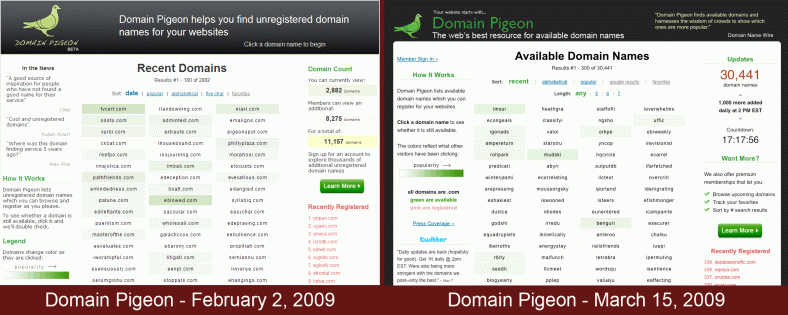
I spent a lot of time prior to launch working on the site’s layout. I felt that a well designed, usable homepage would have a tremendous impact on visitors. Believing this, I spent a lot of time tweaking font sizes, adjusting colors, and repositioning elements until I finally had a site that I was proud of.
Strangely enough—and this is symptomatic of the problem—I was more concerned about what people would say about how the site LOOKED rather than what they would say about what it DID. And so, that last Thursday in January, I posted a link on HackerNews and asked for feedback.
Their comments were, as always, constructive and insightful. Though there were a few recommendations on some usability issues, most of the feedback was focused on ways I could make it better for finding available domain names.
After the launch I spent even more time tweaking the design. Should the font size for this paragraph be 1.2em or 1.3em? #222222 or #2A2A2A? How could I reword this section to make it more concise? Does making the padding on this element 15px look better than 10px? Should I say “unregistered domains”, “free domains”, or “available domains”? And so on.
I spent the better part of February—the honeymoon stage–making small adjustments like these. I did make a few substantive additions, but I was mostly focused on small design issues. I wanted the site to look perfect.
At some point near the end of the month, frustrated with the decreasing traffic, I took a few evenings off to clear my head and to take a critical look at the situation.
Then it hit me.
A good design can greatly enhance your site, but it will not make it into somethings its not. Like makeup on a woman, it should enhance what’s already there. Design can’t make a bad site good and makeup can’t make an ugly woman beautiful. That is unless you’re drunk on optimism or alcohol.
You shouldn’t get too obsessed with design. Focus on things that will improve your site’s ability to meet its objective. That may sometimes include design, yes, but, don’t neglect content.
During the weeks leading up to the launch and for a few weeks following the launch, I had spent about 80% of my time on design and about 20% on substance. It should have been the other way around.
Had I realized this sooner, I might have launched a few weeks earlier. What’s the worst that could have happened?
People say…
Bad idea, great design – You stop working and move on.
Bad idea, bad design – You also stop working and move on, but at least you didn’t spend all that time on the design.
Great idea, bad design – Now that you know your product is one that people want, go ahead and make it look good.
Great idea, great design – If you’re lucky or talented enough to be in this category, go after it with everything you’ve got.
I shouldn’t have been so concerned about what the people on HackerNews would say about the design. Criticism of your design is not a bad thing IF you have a useful product. Had I known this I could have launched a few weeks earlier and spent that extra time making the site a better destination for people looking for domain names.
There is one downside to this, but I don’t think its as important as people think. If the site looked terrible, its unlikely that it would have been covered by either CNET or RWW. Without their coverage, the site wouldn’t have received nearly as much traffic as it did. But, does that traffic really matter? Don’t get me wrong: traffic does matter, but does THAT traffic really matter? Well, to answer that question, you have to know your audience…
Narrow Down Your Audience
It’s critical to determine who you are building your site for.
Until recently, if asked, I would have said that Domain Pigeon was for “people looking for domain names.” While that may be true, its so broad that it may have actually been harmful. It’d be like Walmart saying that they’re targeting “people who want to buy things.”
There are different types of people looking for domain names. Some have never created a website before and are looking to start one for the first time. Others are professional collectors, individuals who buy and sell domain names for a living.
Who was a I targeting? I never narrowed it down and it wound up derailing my efforts.
If I’m targeting people who have never set up a website before, I should include some basic tutorials to help people get started. I shouldn’t use the word “registrar” because someone who has never had a website is unlikely to know what that is. If I take this route, I should also should make the site completely free because beginners are more likely to click through to GoDaddy and to make a big purchase. They’re unlikely to sign up for the advanced features that might appeal to collectors.
Alternatively, I could target the collectors. In that case, I don’t need to include any tutorials. I could make the search feature interpret regular expressions. Beginners won’t need it, but a technical audience might take advantage of it. If I go this route, I should consider charging for access to the domain names, as I won’t make as much off the registrations, but they’ll likely be a significant percentage who will pay for a quality available domain list.
Because I didn’t narrow down my audience I have this kind of multipurpose frankenstein. The traffic is likely made up of collectors who came across the site by way of one of the blog posts. They get free access to thousands of domain names and they can even sort by the number of Google search results. The beginners—the people who have no experience setting up a site—don’t know about the site because its only been discussed in the tech world and even if they did, they wouldn’t know what to do with it if they did find it.
When I said that the the post-launch traffic might not matter, I meant that it depends on your audience. If I made Domain Pigeon for professional collectors, it really wouldn’t matter how much CNET or RWW covered it. The majority of the traffic would look around the site for a few minutes, leave, and never return. What matters, in this case, is how useful the site is to the professionals. I want them to come back; the RWW crowd is nice too, but they’re not longer term customers.
Your audience determines your business model, your layout, and the features you implement. Take your time to narrow it down and ask yourself if your site is best fit for their purpose.
Sleep
It’s 11pm and you’ve got a decision to make. Stay up and program or hit the sack?
When you only get to program two or three hours a day, the extra hour or two adds up to a significant amount of additional time in the long run. What might have taken six weeks might now only take four. The months are flying by so you better not waste it. Who cares if you’re a little tired the next day? If you don’t put in the extra hours, you’ll never get there, where ever there is. So you program.
Five or six hours later you wake up and you feel like hell. To your wife’s eternal dismay, you hit snooze three or four times and when you finally do get up, shower, and start driving to work you realize you forgot your phone or wallet or whatever.
The day drags on. You feel like a zombie and all you can think about is sleep. Finally, when the work day is over, you head home, prepared for another long night.
When you finally get back to programming again your mind is slow. You make typos. You get distracted easily. You look for excuses not to write that next line of code.
What you don’t realize is that that extra two hours you got in the night before has just messed up the entire day. Not only does the other 70% of your day suck because you’re so tired, but when you do get around to programming again you’re so slow that you barely make any progress. Ironically, the combination of mental slowness and typos might actually result in more work in the long run.
I’m a hypocrite for saying it, and I probably won’t even follow this advice, but sleep. You might not get in as much time at the keyboard and your project might take longer, but you’ll be more productive and you’ll feel better too.
Determine Beforehand how you Measure Success
Domain Pigeon was born out of a desire to learn something new and to prepare me for a startup one day. It’s a nights and weekends project that was never supposed to turn into anything serious.
After the CNET and the RWW reviews a crazy thing happened. It started making money. And the more money it made, the more I cared about how much money it made. It wasn’t a quick change. At first, I’d say to myself “This looks bad. It’s going to drive away customers. I need to fix it sometime.” But as the days went on all I saw were the blemishes and that’s all I wanted to work on. It didn’t matter that there were a ton of things that I had yet to learn. If the site didn’t look good it wouldn’t make as much money and if the site wasn’t making money, it wouldn’t be successful.
Ask yourself why you’re doing what you’re doing.
Money? Independence? Recognition? A challenge? Purpose? Enjoyment? Learning?
There’s nothing wrong with any of these—figure out which are important to you and measure your success based on how much you’ve achieved those things.
It’s easy to lose focus. The best way to stay the course is to determine what you value and stick to pursuits that help you achieve those things.
Use Your Product
Stupidly, I never really used Domain Pigeon to find domain names. While I was so busy building a site to help people find available domain names, I wasn’t in need of one myself.
About a week ago, just to see, I started exploring Domain Pigeon to see if I could find a good domain name for a future web app or company. Something short, pronounceable, and memorable. After about of an hour of searching, page after page, I figured out a clue as to why Domain Pigeon’s traffic wasn’t growing: most of the domain names are terrible.
From the homepage as I write this: bicuspi.com, icabbages.com, harmonisati.com, eearldom.com, westsu.com, laddertourna.com, uppercru.com, hyperbolicfu.com.
Unfortunately, its not an easy fix. Algorithmically determining which domain names are good and which are bad is a tough problem. Most of the obviously pronounceable ones, like words in a dictionary, are registered. Even if it could be done, tastes vary. Examining some of the domain names that have already been registered show names like “bezzl.com”, “circleregister.com” and “masterofthe.com”. Would you rather see 10K domain names that have a high probability of being good or the same 10K names mixed in with 90K names which are likely not good, but hey, you never know?
Looking Forward
There’s a lot of things that can be improved with Domain Pigeon. There’s too many bad domain names and too few good ones, there’s no way to generate domain names around certain words, and there’s too little traffic for the colors to be relevant. With some more work and a bit of marketing, who knows what will happen. :)


 Matt Mazur